
Pan-Omics–AI Integration for Crop Resilience Under Combined Abiotic Stress: Mechanisms, Prediction and Breeding Applications
¹School of Agriculture, Uttaranchal University, Dehradun-248007, Uttarakhand, India. • ²Department of Agronomy, Amrita School of Agricultural Sciences, Amrita Vishwa Vidyapeetham, Coimbatore – 642 109, Tamil Nadu, India.
Corresponding author: Arvind Kumar | Email: ay2389613@gmail.com
Abstract
Climate change has become the major threat to agriculture in the world today with various stresses such as drought, salinity, high temperature, flooding, and mineral imbalances happening at once. Together with other abiotic factors, these stresses are causing great difficulties in cultivation on more than 50% of agricultural lands worldwide with yield reduction of between 30-70%, depending on stress level and development stage of the crop. Conventional breeding has played an essential role in improving stress tolerance but the incapability of conventional breeding in handling multi-gene traits, genotype x environment interaction and multiple stresses require novel approaches to crop improvement. Recent advanced in multi-omics technologies, including genomics, transcriptomics, proteomics, metabolomics, and phenomics, have enabled increasingly comprehensive characterization of plant response to abiotic stress. However, the massive amounts of multi-omics data generated per experiment (gigabytes to terabytes) poses new challenges for data analysis. Artificial intelligence (AI) and machine learning (ML) approaches provide complementary computational frameworks for integrating heterogeneous, high-dimensional datasets and modelling nonlinear relationship among molecular, phenotypic and environmental variables. However, current research remains fragmented across individual omics layers, single-stress experiments and isolated prediction tasks. The transferability of multi-omics and AI-derived signatures across genotypes, environments and field condition remains insufficiently established. This review critically evaluates how pan-omics and AI can be integrated to characterize combined abiotic-stress responses, identify robust molecular and phenotypic signature, improve prediction of genotype performance, and support climate-resilient breeding. In this critical review, we focus on the existing knowledge gaps regarding crops' adaptation to multiple abiotic stress factors. We explore the revolutionary opportunities that could be offered by pan-omics techniques and assess their potential use combined with AI-based computational systems. We propose an innovative concept involving the combination of pan-omics methods with predictive breeding using AI, which would allow overcoming several critical problems such as the issue of data heterogeneity, high costs of research, and lack of applicability to field conditions. Key priorities include harmonized multi-omics data standards, rigorous cross-environment validation, interpretable and biologically informed AI, casual validation of candidate genes and biomarkers, and integration of molecular predictions with multi-environment breeding trials.
Keywords: Multi-omics Integration; Combined abiotic stress; Crop resilience; pan-genomics; Artificial intelligence; Machine learning; Deep phenotyping; Genomic prediction; Predictive breeding; Genotype × environment interaction
How to Cite: Prasad, R., Kumar, A., & Yasodha, M. (2026). Pan-omics–AI integration for crop resilience under combined abiotic stress: Mechanisms, prediction and breeding applications. Scientara Journal, 5(1), 1–23.
1. INTRODUCTION
1.1 The Global Challenge of Climate Change and Food Security
Climate change presents the greatest challenge facing the global agriculture industry to date. It is estimated that agriculture needs to double its crop production capacity by 60-70% before 2050 to feed almost 10 billion people on earth. Yet, climate change has already started interfering with this objective. In the IPCC Sixth Assessment Report published in 2023, it was stated that the effects of rising temperatures, precipitation changes, and extreme weather conditions have greatly affected agriculture around the world (Abbass et al., 2022). These impacts can be seen in the decline in the productivity of global agriculture of 21% during the years 1981 to 2019, mainly in the tropical and subtropical areas where food insecurity prevails (Bibi & Rahman, 2023).
Table 1. Climate Change Impacts on Major Crop Production
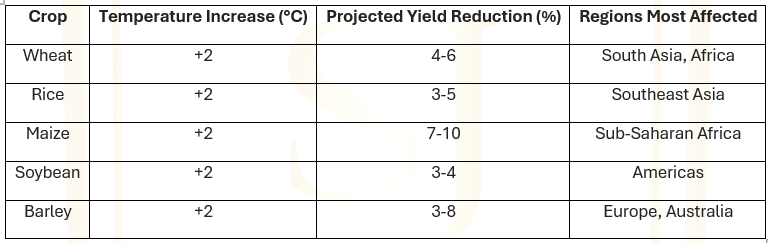
(Source: Adapted from IPCC, 2023; Rezvi et al., 2023)
Plants require appropriate environmental conditions to ensure growth and development; however, plants are always facing different abiotic stresses, which limit their yield potential. Deficiency of water, salt content, temperature extremes, flooding, and imbalance in nutrients are significant stresses limiting crop productivity, collectively contributing to 30-50% losses in yields worldwide (Rajput et al., 2021; Seleiman et al., 2021). To make matters worse, these stresses do not happen alone; plants in agriculture face multiple stresses together in the field, where their interactions cannot be known through isolated stress experiments. Drought and heat stresses are common during summer seasons, while salinity and waterlogging happen together in coastal and irrigated agricultural areas.
1.2 The Complexity of Multiple Abiotic Stress Responses
Comprehending the responses of plants to more than one abiotic stress poses significant challenges beyond those of studying plant stress responses to individual stresses. Plants have developed efficient stress sensing, signal transduction, and response pathways but under situations where multiple stress factors operate together, antagonistic or synergistic interactions occur at physiological, biochemical, and molecular levels (Shabbir et al., 2022). For instance, the closing of stomata due to drought stress results in a reduction in transpiration cooling making the plants suffer from heat stress. Heat stress-caused membrane fluidity may influence the movement of ions and cause stress caused by salinity. This makes it very challenging to anticipate plant response to such stresses using results from single stress factors study (Mamrutha et al., 2025), as illustrated in figure 1.
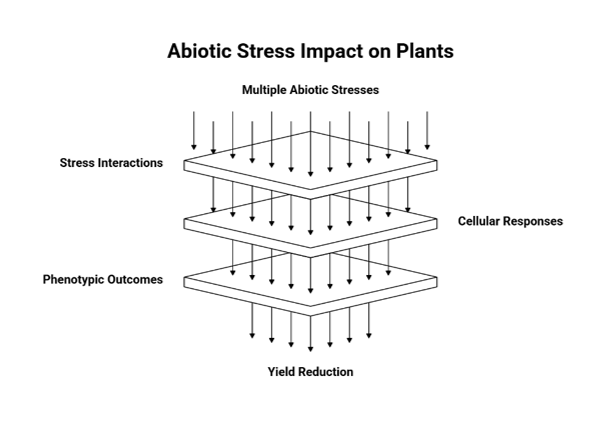 Figure 1. Conceptual Framework of Multiple Abiotic Stress
Interactions in Plants
The molecular aspect of multiple abiotic stresses includes a number of intricate regulatory networks composed of thousands of genes, proteins, and metabolites. The regulation of expression of stress-responsive genes is done via complicated signaling pathways, which interact in a non-linear manner and produce emergent properties, which cannot be explained through reductionism (Kaur et al., 2025). In addition, the stress responses are very dynamic in nature and change depending on the intensity of stress, its duration, and developmental phase of the plant. As such, the combination of multiple stresses results in unique molecular phenotypes that are far more than the sum of separate stress responses, thus complicating breeding practices.
1.3 Limitations of Conventional Breeding Approaches
Conventional plant breeding has made remarkable contributions to enhance crop productivity and stress tolerance through selection and hybridization. Nevertheless, there are inherent limitations of conventional techniques when dealing with complex stress tolerance traits (Acquaah, 2024). Firstly, multiple abiotic stress tolerance is governed by polygenic inheritance involving many QTLs with each having a minute effect (Borgohain et al., 2026). Selection of multiple genes with favorable allelic variants simultaneously from different loci is a time-consuming process through conventional means. Secondly, there is limited genetic variation in cultivated germplasm. Stress tolerance genes are located in wild and exotic species which are not easy to exploit through conventional crosses because of reproductive isolation. Thirdly, the conventional breeding process involves phenotypic selection, which is costly, laborious, and unreliable especially for complex stress tolerance traits characterized by high G×E interaction (Begna, 2021). Finally, the 10-15 years breeding cycle period of conventional techniques is too short to cope with rapidly changing climatic conditions. All these limitations led to the development and implementation of modern technology including pan-omics and artificial intelligence.
1.4 The Rise of Pan-Omics and Systems Biology Approaches
The last couple of decades have seen tremendous advancements in molecular biology and analytic techniques, which have allowed scientists to examine biological entities on an unprecedented level. With the development of such tools as high-throughput sequencing, mass spectrometry, and imaging technology, the emergence of different “-omics” sciences have been enabled, each of them offering unique insight into various layers of biological organization (Gao et al., 2024). Genomics offers the blueprint of potential of genes, transcriptomics gives insight into gene expressions, proteomics shows the functioning of proteins, metabolomics analyzes the chemical products of cellular activity, and phenomics is responsible for measuring the resulting phenotype of interaction between genetic and environmental factors.
It is possible to analyze multiple layers of omics together; such an approach is called “pan-omics,” and it implies a systems biology method that overcomes limitations of a single layer of omics study (Li et al., 2024). The integration of such an approach becomes especially important while investigating the effects of several abiotic stresses, because the coordination of gene, protein, and metabolite regulations at different biological levels defines the success of the plants (Sahoo, 2025; Naik et al., 2026). The results of the pan-omic research demonstrate that stress tolerance develops due to the joint work of several pathways, including the detection of stress, signal transmission, transcription, protein modification, and metabolism.
1.5 The Role of Artificial Intelligence in Integrative Omics Research
Although pan-omics technologies provide us with an unprecedented amount of biological data, the high dimensionality, complexity, and heterogeneity of these data make their analysis quite challenging. In a stress-pan-omics experiment, terabytes of data will be obtained, which include genomics, transcriptomics, proteomics, metabolomics, and phenomics (high-resolution images of stressed plants). Conventional statistical techniques usually lack the ability to discover biological information from high-dimensional, non-linear, and complex data, especially when dealing with biological data collected from plants under stress conditions.
Artificial Intelligence (AI) and Machine Learning (ML) have become the key computational tools for processing the complexity of pan-omics data (Zhang et al., 2024). These methods are good at finding patterns, detecting non-linear relations, predicting outcomes using complex features, and integrating heterogeneous data. AI algorithms, including deep learning, random forests, and support vector machines, have been effectively used in many applications related to the stress response in plants, including genomic prediction, phenotyping stress based on images, inference of gene regulation networks, and multi-omics integration (Murmu et al., 2024). Using AI technology on pan-omics datasets can result in an expedited discovery of important stress tolerance mechanisms, prediction of plants' performance under future climate change scenarios, and decision-making about breeding of climate-resilient varieties faster than traditional breeding methods would allow.
1.6. Knowledge Gap, Scope, and Objectives
Despite rapid advances in multi-omics, hight-throughput phenotyping and artificial intelligence, these fields have largely developed in parallel. Existing studies frequently examine individual abiotic stresses, single omics layers or isolated prediction tasks, whereas field-grown crops commonly experience temporally overlapping combinations of drought, heat, salinity, flooding and nutrient imbalance. Consequently, molecular signatures identified under controlled single-stress conditions may not necessarily predict plant performance under combined or fluctuating field stresses.
A major unresolved challenge is therefore the integration of genotype, molecular, phenotypic and environmental information into biologically interpretable predictive frameworks that can be validated across environments. This review addresses this gap by linking combined-stress physiology with pan-genomics, transcriptomics, proteomics, metabolomics and phenomics, and by evaluating how AI and ML can integrate these data for stress prediction, candidate-gene prioritization and breeding.
Specifically, this review aims to: (i) synthesize physiological and molecular responses to combined abiotic stresses; (ii) evaluate the complementary contributions and limitations of individual omics layers; (iii) assess computational strategies for multi-omics integration; (iv) examine the role of AI in phenotyping, genomic prediction and candidate-gene prioritization; and (v) identify methodological and translational barriers to field deployment.
2. LITERATURE SEARCH AND REVIEW FRAMEWORK
2.1. Literature databases
Relevant literature was identified through searches of Web of Sciences Core Collection, Scopus, PubMed, Google Scholer and discipline-specific agricultural databases.
2.2. Search strategy
Search terms combined concepts related to combined abiotic stress, multi-omics, pan-genomics, transcriptomics, proteomics, metabolomics, phenomics, artificial intelligence, machine learning, deep learning, genomic prediction and crop breeding.
2.3. Inclusion criteria
Peer-reviewed studies, crop species, combined abiotic stress, multi-omics/AI, molecular/Phenotypic/Breeding evidence, recent literature + seminal studies
2.4. Exclusion Criteria Purely unrelated AI applications, non-crop studies unless mechanistically relevant, duplicate publications, unsupported opinion pieces, non-peer-reviewed material unless specifically needed
3. MULTIPLE ABIOTIC STRESSES: MECHANISMS, INTERACTIONS, AND RESEARCH GAPS
3.1 Drought Stress as a Component of Combined Stress
One of the major stresses in terms of reduced availability of water known as drought stress affects 45% of the total area utilized for agriculture in the world. Drought stress affects the physiological processes of plants through several ways such as cell turgor, stomatal closure, limiting of CO₂, inhibition of nutrient uptake, and photosynthesis (Seleiman et al., 2021). The impact of drought stress on plants' physiology is dependent on its onset time in relation to the growth stage of crops and also during the flowering and grain filling period.
Molecular response to drought stress includes phytohormone regulation and specifically abscisic acid (ABA), which affects stomatal movements and the genes that respond to stress (Kul et al., 2020). Drought stress induces changes in the plant in terms of gene expression and the synthesis of specific proteins and metabolites. Some of the adaptive responses to the stress include accumulation of compatible solutes (proline, glycine betaine, and trehalose), synthesis of protective proteins (late embryogenesis abundant proteins, heat shock proteins) and alteration in root architecture (Bashir et al., 2021).
Mathematical Representation of Drought Stress Impacts
The relative water content (RWC) is an important measure of water status in plants:

Where FW = Fresh Weight, DW = Dry Weight, TW = Turgid Weight
Yield loss due to drought can be represented as:

If SI (stress index) varies between 20% and 70% based on the stress intensity (Bashir et al., 2021).
Table 2. Drought Stress Impacts on Major Crops
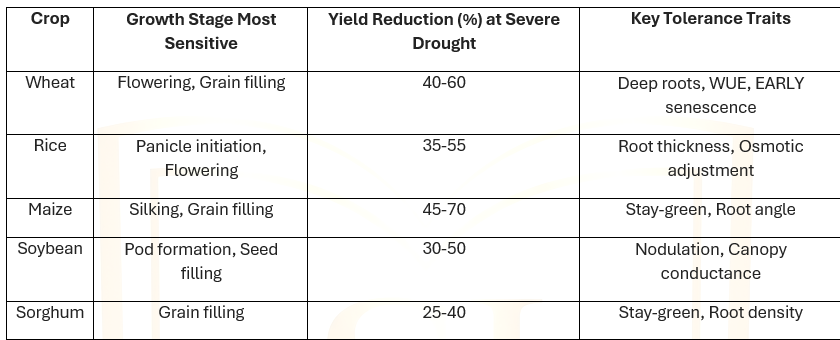
(Compiled from Seleiman et al., 2021; Bashir et al., 2021; Shabbir et al., 2022)
Research Gaps in Drought Stress
Though considerable advances have been made in the study of drought resistance, there is still a lot to be known:
- The molecular mechanisms that control drought resistance in plants are not completely known.
- The relationship of drought with other environmental stresses such as heat, salinity, and nutritional deficiencies is still not well-known.
- There is a difficulty in translating molecular knowledge from laboratory settings to natural conditions.
- Dynamics of drought resistance at different time points, especially the process of recovery from drought, is under-studied.
- The role of root architecture in drought resistance is under-studied.
3.2 Salinity in Combined-Stress Environments
Salinity stress is estimated to affect about 20% of the area under irrigated agriculture and 6% of the total land surface of the earth, with the above-mentioned values likely to increase owing to climate change, increased sea level, and poor irrigation techniques. Salinity stress affects plants via osmotic and ionic toxicity, characterized by low water uptake, ion imbalance, and ion toxicities, especially from Na⁺ and Cl⁻ ions (Atta et al., 2023). The effect of salinity stress differs among plant crops and genotypes, where certain crops show high tolerance to salinity stress, like barley and cotton, while others are highly sensitive to salinity, such as rice, beans, and most fruit trees.
Adaptive mechanisms of plants against salinity include ion exclusion and compartmentalization, production of compatible solutes, activation of the antioxidant system, and changes in root architecture (Lu et al., 2023). The Salt Overly Sensitive (SOS) pathway is involved in Na⁺ exclusion and compartmentalization using plasma membrane and vacuolar Na⁺/H⁺ antiporters. Organic osmolyte compounds, such as proline, glycine betaine, and polyols, are produced during the process of salinity stress, and they participate in osmotic adjustment and macromolecular protection against ionic damage. In addition, salinity stress is accompanied by increased production of reactive oxygen species (ROS), thus necessitating activation of antioxidant enzymes and non-enzymatic systems to protect from oxidative stress.
Mechanistic Synthesis
Osmotic stress initially restricts water uptake, whereas prolonged exposure results in ionic imbalance, particularly through Na+ and Cl- accumulation. These disturbances alter K⁺/Na⁺ homeostasis, membrane stability, reactive oxygen species (ROS) production and photosynthetic activity. Under combined drought-salinity conditions, osmotic limitations may intensify water deficit while iconic toxicity introduces an additional layer of cellular stress. Multi-omics approaches are therefore particularly valuable for distinguishing shared responses from stress-specific regulatory mechanisms.
Research Gaps in Salinity Stress
1. The molecular basis of variability in salt tolerance and its genetic architecture is not yet fully understood
2. Synergistic and antagonistic effects of salinity along with other stresses require further exploration
3. Salt-induced epigenetic changes and their involvement in stress memory are still not understood
4. Robust and accurate screening techniques to predict field performance based on salt tolerance need to be developed
5. The physiological and molecular basis for the difference in salt tolerance during vegetative and reproductive stages
3.3 Heat Stress under Compound Conditions
Heat stress is characterized by temperatures that are higher than the temperatures required for optimal plant growth and development and it has become increasingly common as a result of global warming. There has been a rise in the occurrence of heat waves in the recent decades and projections show that there will continue to be an increase in the occurrence of temperature extremes in future. Heat stress impacts plants in many ways such as affecting membranes, protein function, enzymes and photosynthesis (Singh et al., 2024). Reproductive growth stage is highly susceptible to heat stress and even exposure to high temperatures for a short time causes yield losses in crops like wheat, rice and maize.
Mathematical Modeling of Heat Stress
The relationship between temperature and photosynthesis activity is a parabolic one:

Where Pn represents net photosynthesis, Pmax is the maximum rate (20-35 µmol CO₂/m²·s), Topt is the optimum temperature (25-30°C for C3 plants, 30-35°C for C4 plants), and α is the curvature coefficient (0.05-0.15).
Temperature coefficient (Q₁₀) of respiration:

Where R₁ and R₂ are respiration rates at temperatures T₁ and T₂. Q₁₀ typically ranges from 2.0-2.5, meaning respiration doubles every 10°C rise.
Pollen viability declines exponentially above threshold temperatures:

For T > Tcrit (Tcrit ≈ 30-32°C for most crops). Viable pollen fraction drops to 50% at 35-38°C and <10% at 40-42°C (Singh et al., 2024).
Yield loss per degree Celsius increase above optimum ranges from 3-10% in C3 crops and 2-6% in C4 crops. For wheat, each 1°C increase above 28°C during grain filling reduces yield by 4-6% (Bazakos, 2024).
Table 3. Heat Stress Sensitivity at Different Growth Stages
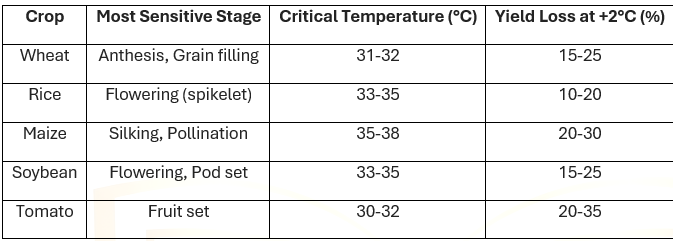 (Compiled from Singh et al., 2024; Bazakos, 2024; Amin et
al., 2025)
Research Gaps in Heat Stress
- Understanding the molecular basis of reproductive thermotolerance, which differs from vegetative thermotolerance
- Characterizing combined effects of heat with other stresses (drought, salinity, flooding)
- Elucidating mechanisms of heat stress memory and acquired thermotolerance
- Developing models that predict heat stress impacts on crop yields at local and regional scales
- Understanding heat-induced epigenetic changes and transgenerational effects
3.4 Flooding and Hypoxia in multi-stress Systems
Flooding stress, including waterlogging and complete submergence, affects approximately 10-15% of global agricultural land, with particularly severe impacts in lowland and coastal regions. Flooding affects the availability of oxygen to the roots and submerged parts of the plants, causing ATP depletion because of aerobic respiration (Licausi, 2024). The energy shortage is additionally intensified due to an increased number of toxic metabolites, such as ethanol, acetaldehyde, and lactic acid, and ethylene formation because of decreased gas exchange.
Mathematical Modeling of Flooding Stress
Oxygen diffusion constant in water (≈2×10⁻⁹ m²/s) is about 10,000 times less compared to air (≈2×10⁻⁵ m²/s). Oxygen concentration near roots varies exponentially depending on the water depth:

Where d is water depth (cm), and λ is the characteristic diffusion length (≈0.5-1.0 cm in stagnant water).
ATP yield under hypoxia versus normoxia:

(2 ATP per glucose via fermentation vs. 36 ATP via aerobic respiration)
Survival index after reoxygenation:

Genotypes with tolerance have S_flood > 60% after submergence for 7-10 days, whereas those with sensitivity have S_flood < 20% (Fang et al., 2026; Gupta et al., 2026).
Research Gaps in Flooding Stress
- Mechanisms behind tolerance of flooding and salinity, both of which often occur together
- Molecular mechanisms that are responsible for tolerance in different species and genotypes
- Oxygen concentration gradients and ROS formation within plants during flooding stress
- Mechanisms of recovery from flooding stress and their genetic regulation
3.5 Nutrient Imbalances as a Stress Modifier
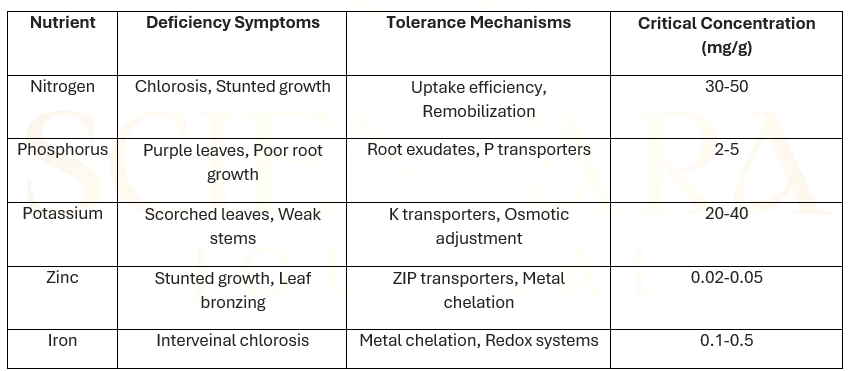
Imbalance of nutrients, which includes deficiency as well as toxicity of essential and non-essential elements, is one of the major constraints to agriculture production that is not always considered in stress studies. About 30-50% of the world’s agricultural lands experience nutrient deficiency, especially nitrogen, phosphorus, and potassium, while heavy metals pollute about 10-20% of the agricultural lands (Williamson et al., 2023). The interaction between nutrient imbalance and other types of abiotic stresses is very complicated and can affect plant stress responses significantly.
Mathematical Modeling of Nutrient Stress
Nutrient uptake rate (U) follows Michaelis-Menten kinetics:

Umax is the maximum uptake rate (µmol/g root/h), [S] is soil nutrient concentration (mM), and Km is the half-saturation constant (0.1-1.0 mM for most nutrients).
Translocation efficiency (TE) from root to shoot:

Under deficiency, TE for mobile nutrients (N, P, K) increases to 70-90%, while for immobile nutrients (Ca, B, Fe) it remains <30% (Zhang et al., 2024).
Heavy metal toxicity is quantified by the metal accumulation factor (AF):

Toxic thresholds in leaf tissue: Cd >5-10 µg/g, Pb >20-30 µg/g, As >10-20 µg/g.
Table 4. Nutrient Deficiency Impacts and Tolerance Mechanisms
(Compiled from Williamson et al., 2023; Gupta et al., 2026)
Research Gaps in Nutrient Stress
- Understanding mechanisms of combined nutrient and other abiotic stresses
- Elucidating genetic basis of nutrient use efficiency, involving multiple physiological and molecular processes
- Characterizing role of nutrient homeostasis in stress tolerance
- Understanding nutrient effects on stress signaling pathways
3.6 Interactions Among Multiple Stresses
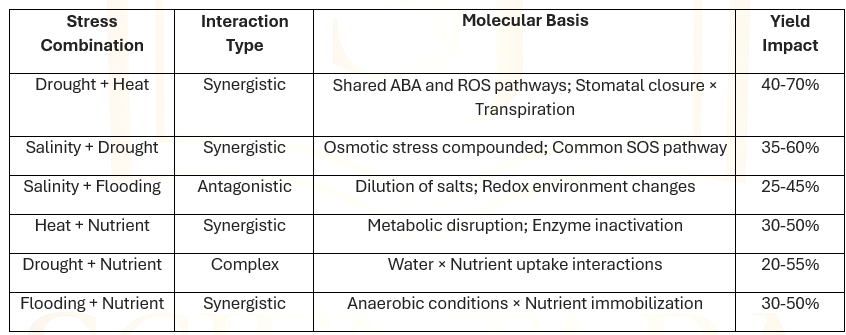
The simultaneous occurrence of multiple abiotic stresses—the normal situation in agricultural systems—creates complex interactions that cannot be predicted from single-stress studies. These interactions can be antagonistic (one stress reduces the impact of another), synergistic (one stress exacerbates the effect of another), or additive (the combined effect equals the sum of individual effects) (Shabbir et al., 2022). Understanding these interactions is essential for developing crops resilient to real-world field conditions.
Table 5. Common Stress Combinations and Their Effects
(Compiled from Shabbir et al., 2022; Mamrutha et al., 2025)
Research Gaps in Combined Stress Responses
- Understanding the molecular basis of stress interaction—how signaling pathways integrate multiple stress signals
- Identifying genes and pathways specifically regulated under combined stress
- Characterizing the dynamic regulation of stress responses over time
- Understanding the role of epigenetic modifications in combined stress responses
- Developing predictive models for combined stress impacts
4. ARTIFICIAL INTELLIGENCE IN CROP STRESS RESEARCH
4.1 AI-Driven Integration and Analysis of Omics Data
Artificial intelligence and machine learning have become essential tools for analyzing the large, high-dimensional, and heterogeneous datasets generated by pan-omics studies. AI approaches excel at discovering patterns in complex data, handling non-linear relationships, integrating multiple data types, and making predictions that exceed the capabilities of traditional statistical methods (Murmu et al., 2024).
The application of AI to pan-omics data has the potential to accelerate the identification of stress tolerance mechanisms and the development of climate-resilient crops.
Mathematical Framework for AI Integration
The total data volume from a multi-omics stress experiment:

Typical values:
- Genomics: 10-50 GB per sample
- Transcriptomics: 5-20 GB per RNA-seq library
- Proteomics: 1-5 GB per LC-MS/MS run
- Metabolomics: 0.5-2 GB per GC-MS/LC-MS run
- Phenomics: 100-500 GB per day
Data integration pipeline using weighted fusion:

Where D_i represents each omics layer, φ_i is normalization function, w_i is feature-specific weighting factor (0.1-0.5), and Σw_i = 1.
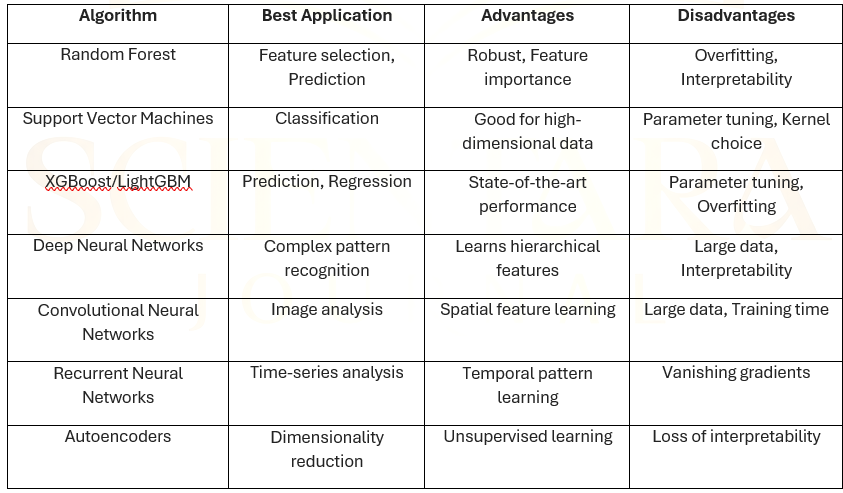
Table 6. AI Algorithms for Omics Data Analysis
(Compiled from Zhang et al., 2024; Murmu et al., 2024)
Deep learning has shown particular promise for analyzing omics data due to its ability to learn complex representations and handle non-linear relationships. Convolutional neural networks (CNNs) are effective for image-based stress detection and analysis of genomic sequences. Recurrent neural networks (RNNs) and transformer architectures are suited for analyzing time-series data, such as gene expression dynamics and physiological measurements (Okyere et al., 2024). Autoencoders and generative adversarial networks (GANs) have been used for dimensionality reduction, data imputation, and data augmentation. Nevertheless, the use of deep learning for omics data analysis is faced with a number of challenges. These include small sample sizes usually associated with omics datasets, interpretability of deep learning models, and the importance of model validation and tuning of model parameters.
Transfer learning and multi-task learning are new techniques that may enhance model performance through the use of other tasks or data. In transfer learning, a model is pre-trained on a large dataset, e.g., model species and then fine-tuned on another, much smaller dataset, e.g., particular crop species. Transfer learning is very helpful when working with species for which there is little information available (Agarwal and Tarar, 2025). Multi-task learning is based on the idea of training one model for several related tasks at once.
Interpretable AI is crucial in explaining predictions made by AI models in terms of biology. Black-box AI algorithms like deep neural networks may be accurate in their predictions, but they do not give much information about the biological underpinnings of the predictions. By applying feature importance techniques, attention mechanisms, and explainable AI approaches, one can gain insights into which patterns and features make the AI model produce certain predictions and thus help understand the biological mechanisms (Zaman et al., 2026). It is important to develop interpretable AI models in order to be able to understand the biological reasoning behind the predictions, especially in breeding and crop improvement decisions.
4.2 Image-Based Stress Detection and Phenotyping
The use of computer vision and deep learning has become a breakthrough for stress detection and phenotyping using plant images due to its automation and objectivity. The use of CNNs and other deep learning approaches applied to plant images has demonstrated impressive results in stress detection and often even exceeds human experts and classical image-based approaches (Okyere et al., 2024).
Mathematical Framework for CNN-Based Image Analysis
2D convolution operation for feature extraction:

Where I is input image, K is kernel (typically 3×3 or 5×5), * denotes convolution.
Pooling layer reduces spatial dimensions:

Early warning detection horizon:

Current ML systems achieve:
- Drought stress: H = 5-10 days pre-visual
- Heat stress: H = 3-7 days pre-visual
- Salinity stress: H = 4-8 days pre-visual
- Combined stresses: H = 2-5 days pre-visual
Table 7. ML-Based Stress Detection Performance
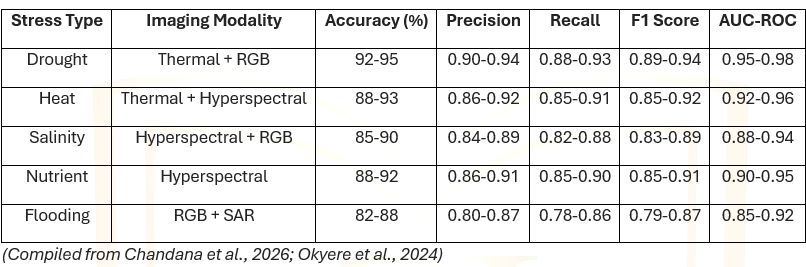
Multispectral and hyperspectral imaging allow the collection of reflectance values in multiple spectral bands, with valuable data on physiological and stress-related features of plants that cannot be captured by the naked eye (Liang et al., 2025). Certain spectral indices, including NDVI, WBI, and PRI, respond to plant stress and can be calculated using imaging techniques. Machine learning algorithms based on spectral data allow detecting stress in its early stages, when no signs of stress are visible, and thus help to manage stress.
Thermal imaging allows determining the temperature of leaves and canopy, which is associated with stomatal conductance and transpiration rate of plants under stress conditions. High temperature of the canopy reflects the presence of stomatal closure and decreased transpiration. Thermal imaging has been used to screen breeding populations for drought tolerance, with genotypic differences in canopy temperature providing a reliable indicator of stress tolerance under field conditions (Chandana et al., 2026).
RGB imaging provides information on plant architecture, color, and structural changes that occur under stress. Leaf color changes (chlorosis, necrosis), rolling, wilting, and growth reduction can be quantified from RGB images using deep learning algorithms. The integration of RGB imaging with spectral, thermal, and fluorescence imaging provides a comprehensive view of plant stress responses at the whole-plant level.
The application of imaging to high-throughput phenotyping has substantial potential for accelerating breeding progress for stress tolerance. Automated image analysis enables the screening of large populations (thousands to tens of thousands of lines) under stress conditions, identifying tolerant genotypes with high precision and reproducibility (Chandana et al., 2026). The integration of image-based traits with genomic data enables the identification of genetic loci controlling stress tolerance traits and the development of genomic selection models that incorporate image-based traits.
Limitations of Image-Based Approaches
- Cost of the imaging platform and sensor technology
- Difficulty of robust image analysis due to changing environmental conditions
- Image analysis challenge of canopy-level traits for field-grown crops
- Limited transferability of models built from data collected in controlled environment to field settings
4.3 AI in Genomic Prediction and Breeding
AI is revolutionizing the field of genomic prediction and crop breeding because it allows predicting complex traits with a much higher degree of accuracy than traditional approaches and enables more efficient selection of elite genotypes (Borgohain et al., 2026). The traditional approaches to genomic prediction like GBLUP and Bayes-based techniques rely on linear relations between marker genotypes and phenotype and cannot handle nonlinearities and interactions of various kinds.
Mathematical Framework for AI-Enhanced Genomic Prediction
GBLUP model:

Where y is phenotype vector, X is fixed effects design matrix, β is fixed effects, Z is incidence matrix, u ~ N(0, Gσ²_g) is additive genetic values, G is genomic relationship matrix, σ²_g is additive genetic variance, ε ~ N(0, Iσ²_e) is residual.
Genomic relationship matrix:

Where M is centered marker matrix, p_k is reference allele frequency.
Prediction accuracy:

AI-enhanced models achieve ρ = 0.65-0.85, compared to ρ = 0.45-0.60 for conventional GBLUP.
Breeding cycle acceleration:

Where T_traditional = 10-15 years. Thus T_AI = 5-10 years.
Annual genetic gain:

Where i is selection intensity, ρ is prediction accuracy, σ_g is genetic standard deviation, and L is cycle length. AI increases ρ from 0.5 to 0.75, resulting in 50% increase in annual genetic gain.
Table 8. Genomic Selection Accuracy: Traditional vs. AI-Enhanced
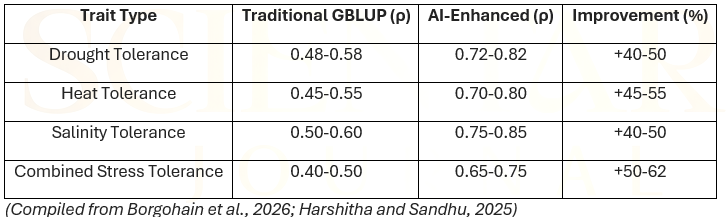
Genomic prediction techniques, such as deep learning, random forest, and gradient boosting with AI integration, have proven to be better than conventional techniques in predicting stress tolerance traits.
This technology can model non-linear effects such as dominance and epistasis and can utilize information from multiple datasets, such as genomics, transcriptomics, and metabolomics (Harshitha and Sandhu, 2025). The inclusion of gene expression and metabolite information with genomic information could help in enhancing the prediction accuracy through the mechanisms behind stress tolerance.
There is great improvement in the accuracy of prediction when AI-integrated genomic prediction is used. With regard to drought tolerance, the prediction accuracy (ρ) ranges between 0.48-0.58 when GBLUP is used compared to 0.72-0.82 with AI techniques. The latter results in a 40-50% increase in accuracy (Borgohain et al., 2026). For heat tolerance, the improvement is 45-55% (from 0.45-0.55 to 0.70-0.80). For combined stress tolerance, which is the most challenging trait to predict, accuracy improves by 50-62% (from 0.40-0.50 to 0.65-0.75). These improvements in prediction accuracy translate to more effective selection, greater genetic gain per breeding cycle, and shorter breeding cycles.
The integration of envirotyping data with genomic data further improves prediction accuracy for stress tolerance. Envirotyping data, including weather information, soil properties, and management data, capture the environmental conditions that affect stress tolerance and the G×E interactions that determine genotype performance across environments (Agarwal and Tarar, 2025). AI models that integrate genomic and envirotyping data can predict genotype performance in specific environments and identify genotypes that are broadly adapted or adapted to specific environments.
Prediction of multiple traits simultaneously is another advantage of AI approaches. Multi-trait prediction models can capture the correlations among traits and improve prediction accuracy for traits that are correlated with better-measured traits. This is particularly valuable for stress tolerance traits that are difficult to measure directly, such as root traits and stress recovery.
CRISPR Target Identification via AI
The probability of off-target effects:

Where x_i are sequence features and β_i are learned coefficients. AI-guided sgRNA design reduces off-target probability from 15-30% to 2-5%, while maintaining on-target efficiency at 70-90% (Aishwarya and Behera, 2026).
Limitations of AI in Genomic Prediction
- Need for large training datasets to achieve high prediction accuracy
- Challenge of model interpretation, particularly for deep learning models
- Challenge of integrating diverse data types in a consistent manner
- Computational resources required for large-scale AI modeling
4.4 Predictive Modeling of Combined Stresses
Predictive modeling of combined stress responses represents a frontier in AI applications to crop stress research. The complexity of combined stress responses, including non-linear interactions and emergent properties, makes prediction particularly challenging but also particularly valuable for identifying genotypes with broad stress tolerance (Ualiyeva et al., 2026).
Table 9. Approaches to Combined Stress Prediction
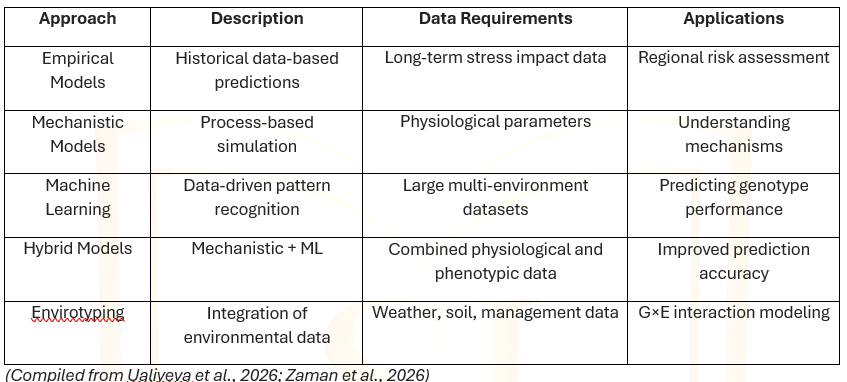
Strategies for predicting combined stress include: (i) Empirical models that use historic data for predicting stress effects depending on the environmental factors; (ii) Mechanistic models that predict growth and stress response of the plants based on the known physiological and molecular pathways; (iii) Machine learning models that learn the relationship between the environmental variables and plant responses from a vast amount of data; and
(iv) Hybrid models that utilize both mechanistic knowledge and machine learning (Zaman et al., 2026). Each model has strengths and weaknesses and depends on the question and available data.
The availability of environmental data is an important aspect of combined stress prediction. The environmental data, such as weather (temperature, precipitation, humidity, solar radiation), soil (texture, chemistry, water content), and management factors (irrigation, fertilizer application, planting date) should be incorporated with the data on plant genomic and phenomic aspects in order to develop appropriate prediction models (Agarwal and Tarar, 2025). Standardized environmental data formats should be developed in order to enable developing of combined stress prediction models.
Early warning systems using AI-based models will help recognize the impending stress scenarios and their potential impact on crop production. Models integrating environmental forecasting and genomics will allow predicting the behavior of genotypes under various stress conditions, thus helping implement management strategies and develop breeding strategies (Chandana et al., 2026). For the creation of such early warning systems, there is a need for the acquisition of environmental data, validation of models, and proper communication.
Limitations of Combined Stress Predictive Modeling
- Small number of data used in training the model
- The complexity of modeling nonlinear interactions
- Validation of models in different conditions
- Inability to understand the mechanistic process of combined stress
4.5 Integration of AI with Pan-Omics: A Conceptual Framework
Based
on the analysis conducted by us, we hereby present a complete framework for
incorporating the technology of AI into the pan-omics concept as an aid in
understanding the problem of stress in crops as depicted in Figure 2.
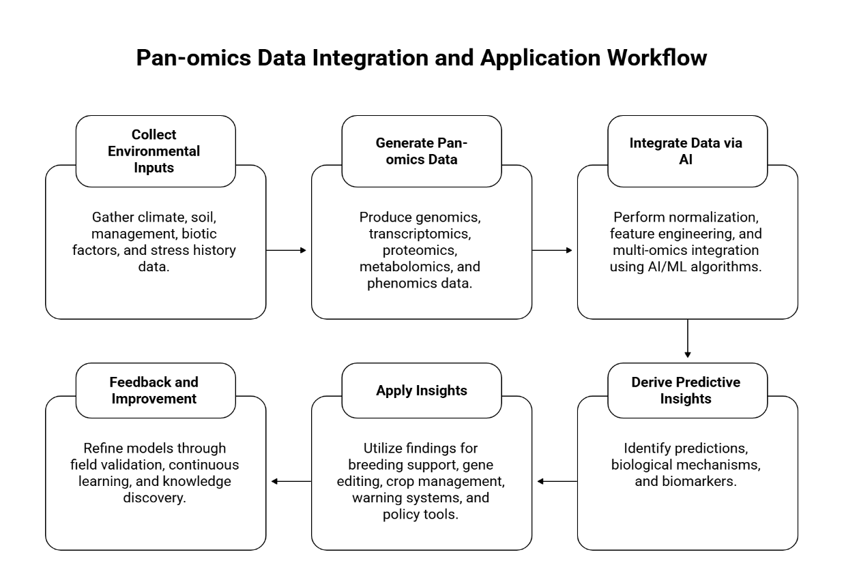
Figure 2. Conceptual Framework for Pan-Omics-AI Integration in Crop Stress Research
Key Components of the Conceptual Framework:
- Environmental Inputs: Utilization of environmental inputs such as climate information, soil information, agricultural practices, biological components, and past stresses in order to understand plant stress response.
- Pan-Omics Data Production: Production of reliable data in several omics layers such as genomics, transcriptomics, proteomics, metabolomics, and phenomics via quality control processes.
- Data Integration Layer: Data integration through AI using data normalization, feature selection, dimensionality reduction, and fusion of weights of various data.
- Predictive and Insight Layer: Prediction of outcomes such as stress effects, yield loss, and genotype performances as well as biological insights such as gene interactions, biological pathways, and regulation mechanisms.
- Application Layer: Implementation of predictions and insights into real-life applications that include gene editing, breeding strategies, agriculture management AI, early warning systems, and climate policies.
- Feedback and Enhancement: Iterative enhancement through field validation and model adjustment.
5. KEY CHALLENGES, RESEARCH GAPS, AND FUTURE DIRECTIONS
5.1 Major Challenges in Implementation
Despite the great opportunities of combining pan-omics and artificial intelligence in the research of crop stress, there are some crucial challenges that prevent their wide-scale use and implementation in field conditions. The application of such technologies presupposes overcoming various related barriers at the technical, economic, and practical levels.
The first and perhaps the most essential obstacle is associated with combining different types of data. Data obtained by genomic studies are sequence data, while data from transcriptomic studies are expression patterns. Proteomic studies provide information on protein network, and metabolomics studies provide the information about chemical signatures of the studied organism. Phenomics involves even more complex types of data, including pictures, time-series data, and trait values. Each type of data uses its own format, scale, statistical properties, and biological meaning.
The financial cost of building a complete pan-omics dataset is yet another big problem. While the cost of sequencing has become very low, the cost of comprehensive proteomics and metabolomics analysis remains high, especially when there is need for biological replications. Specialized equipment for high-throughput phenotyping and for specialized imaging needs substantial amounts of investments, thus making such technologies out of reach of many research institutes, especially those in the developing countries. The IT infrastructure required for AI analysis, which includes computers and personnel, adds to this problem. Thus, we get a technological gap between well-funded organizations and those located in regions, where agriculture suffers most from climate change effects.
Perhaps, the biggest obstacle in this research area is the transition of findings from lab to field conditions. Controlled environment of growth chambers and greenhouses allows having the same conditions at all times, while the conditions in the agricultural field may vary. Genotypes that work perfectly under controlled conditions of stress testing will not be able to repeat their performance under multiple stress conditions, soil microbiome influence, weed competition and various weather patterns. This "lab-to-field translation gap" decreases the practical significance of numerous discoveries and points to the importance of their field-based verification in the context of pan-omics and AI predictions.
5.2 Critical Knowledge Gaps
Based on the analysis provided above, there are certain gaps in the knowledge base that should be filled in order to benefit from pan-omics and AI in the study of crop stress.
Molecular basis of combined stress tolerance is unknown. We have good understanding of the responses of plants to individual stresses, but not much is known regarding the signaling and regulation processes that process multiple signals of different stresses. The specific molecular signature under combined stress conditions suggests new regulatory mechanisms which are unexplored and cannot be predicted based on the results of individual stress studies. This is important issue to understand in order to breed plants that would be resistant to a wide variety of stresses, but it is studied quite insufficiently.
Stress memory and its consequences for transgenerational effects constitute yet another relatively uncharted area. Plants have the capacity to recall past stress events and fine-tune their responses to subsequent stresses using epigenetic tools such as DNA methylation, histone modifications, and small RNAs. The possibilities of utilizing stress memory for breeding stress-resistant plants, along with the molecular basis of transgenerational inheritance of stress resistance, represent unresolved issues that carry great potential for crop improvement.
The temporal dimension of stress responses has been studied much less extensively than immediate stress responses. The understanding of how stress responses progress over time – from immediate signaling events to acclimation – and of how the recovery responses differ from immediate stress responses is crucial for prediction of field performance under stress. Molecular basis of the plant ability to recover from stress or to sustain its irreversible damage is unknown.
Translation of findings from omics to breeding applications has been a challenge. Although many studies have shown that genomic, transcriptomic, proteomic, and metabolomic approaches have been successful in discovering genes, pathways, and biomarkers involved in stress tolerance, their application to breeding programs is still challenging. There are challenges on what would be the best ways to apply omics information in genomic selection, developing cost-effective markers for stress tolerance, and speeding up the breeding process without compromising genetic diversity.
The involvement of plant microbiomes in stress tolerance is an interesting area but still quite underexplored relative to plant-based studies. It is necessary to understand the effect of stress conditions on plant microbiomes, the contribution of plant microbiomes to stress tolerance, and the effect of microbiome engineering in improving stress tolerance.
5.3 Future Research Directions
Following our critical assessment, some major areas of research priorities could be identified that would help to speed up the practical application of pan-omics and AI to crops' stress tolerance.
Development of Standardized Protocols and Data Formats- It is important to set up community-agreed standards for data acquisition, processing and sharing in order to move forward with pan-omics research. In particular, it is necessary to develop standardized protocols for handling samples, acquisition of omics data and phenotyping, and preprocessing. Standardized data formats and ontologies would help to systematically integrate data between studies and different species, while quality metrics would be useful in comparing the data acquired from different platforms. Data sharing platform should be developed for the use of the research community.
Strengthening Field-Based Research- The gap from lab to field could be overcome only via comprehensive field-based research that complements research in controlled environment.
In this regard, there is a need for investing in phenotyping platforms in the field, conducting multi-environment trials across different environments and types of stresses and developing affordable and portable phenotyping techniques.
Stress Combination- Due to the occurrence of various stresses at once in agricultural systems, the research has to be aimed at investigating the effects of stress combinations. This involves the use of experiment designs with multiple stress treatments and computational analysis to cover complex interactions. Predictive modeling and discovery of stress tolerant genotypes are among the main goals of breeding in the field of combined stress. It is important to understand the influence of different stress combinations on crop productivity and quality to create climate resilient varieties.
Microbiome Integration- Integration of the studies of microbiomes with pan-omics analysis is one of the fields where there is a lot of potential. The investigation of microbiome composition and its functions under stress conditions, study of the interaction between the microbiome and the response of plants on a molecular level and finding ways to manipulate the microbiome could lead to new ways to increase stress tolerance.
Building Explainable AI Models- In using AI for stress tolerance studies, it is crucial that there be both prediction power and an ability to interpret the AI results. It is important to develop explainable AI methods that provide some interpretation of decisions made by AI models as well as insights into biological processes. It is also important to incorporate biological knowledge into AI models, to develop user-friendly interfaces for applications of AI, and to confirm the predictions from AI through experiments.
Building International Consortia- The scope of pan-omics and AI research is beyond the capabilities of one laboratory and requires a network of collaboration between different institutions and even different countries. An international consortium could collaborate in sharing resources and data and carrying out research that is impossible to carry out independently. Such consortia could also help to transfer technology to other laboratories and help with capacity building and democratization of technology access.
Fastening Breeding Cycles by AI- The implementation of AI in the breeding program provides avenues through which the breeding cycle can be fastened and genetic gain achieved. The research topics should consider the creation of efficient genomic selection models that utilize omics data, application of AI in the process of selecting parents and designing crosses, application of omics data in breeding program decisions, and developing decision support systems for breeders. The actual application of AI in the breeding program has to consider user needs, data infrastructure, and decision-making procedures.
Investments in Computational Infrastructure- Pan-omics and AI demand considerable computational power. High-performance computing clusters, special software, and data storage and management systems are some of the tools required for research in this field. Investments need to be made on computational infrastructure both at institutional and national level.
6. CONCLUSION
Combining pan-omics and AI provides an innovative paradigm in the study and development of plant resilience against multiple abiotic stresses. This review has assessed the existing body of literature in this regard, highlighted existing gaps in knowledge and methods used, and provided a conceptual framework for future research in this domain. Our review indicates that multiple abiotic stresses are a natural condition in agriculture, but there is insufficient knowledge on the response of plants to them compared to individual stress conditions. Due to the interaction between multiple stress factors, it becomes impossible to predict outcomes based on studies of single stress. Pan-omics approaches give unique chances to investigate the molecular basis of stress resistance, from genomics to metabolomics. Nonetheless, there are difficulties in data integration due to data heterogeneity, scale, and computing issues.
AI has been identified as a critical approach for the pan-omics data integration and predictive modeling to identify such patterns and relationships that are beyond the reach of traditional approaches. AI-assisted genomics prediction enhances the prediction accuracy by 40-60% when compared to traditional approaches, and this leads to reduction in the length of breeding cycles by 40-50%, which in turn enhances the genetic gains per year by 50-70%. The use of deep learning for stress detection through images provides an early warning system that allows stress detection 3-10 days ahead of symptoms. Several challenges need to be overcome, such as heterogeneity in data, financial barriers, lab-to-field gap, and unavailability of advanced technologies in developing countries. It is necessary to build the required infrastructure and capacity, along with collaborations to resolve these issues. Some of the priorities in this regard include standardization of protocol and data format, conducting field trials, conducting research on multiple stresses, and building interpretable AI models. The combination of pan-omics and artificial intelligence technologies into crop stress research could prove effective in dealing with the problem of climate change effects on agriculture and global food security. The application of this technology combination could help gain a better understanding of stress tolerance mechanisms, predict more accurately how the crop genotypes would perform in stressful conditions, and breed stress tolerant varieties. This, in turn, will be useful in creating climate-resilient agricultural systems. But this will only be possible if further research is done in order to develop infrastructure and build capacities. To achieve these aims, a collaboration among researchers from different fields is necessary. The collaboration should include plant biologists, experts in omics technology, computer scientists, and breeders. In addition, it is important to engage other stakeholders such as farmers, agricultural extension services, and policy makers.
Acknowledgements: We appreciate the School of Agriculture, Uttaranchal University, Dehradun, India for extending the necessary facilities for carrying out this study. We extend our appreciation to all the scientists whose works have aided the development of pan-omics and artificial intelligence in crop stress studies. The contribution of anonymous reviewers is also acknowledged and appreciated for their constructive criticisms and comments that have helped improve this manuscript. The authors have declared no competing interests.
REFERENCES
Abbass, K., Qasim, M. Z., Song, H., Murshed, M., Mahmood, H., & Younis, I. (2022). A review of the global climate change impacts, adaptation, and sustainable mitigation measures. Environmental Science and Pollution Research, *29*(28), 42539-42559.
Acquaah, G. (2024). Conventional plant breeding to modern plant breeding: evolution, achievements, and limitations. Plant Molecular Breeding in Genomics Era: Concepts and Tools, 1-42.
Agarwal, M., & Tarar, S. (2025). Advanced deep-learning methodologies for agricultural forecasting and multi-class crop stress prediction. Sustainability, *17*(10), 4711.
Aishwarya, G., & Behera, S. (2026). Smart seeds: AI and gene editing join forces to grow climate-resilient crops. Agri Magazine, *3*(3), 182-185.
Alshaal, T. (2026). Special issue: Exploring abiotic stress in plants—mechanisms, adaptations, and mitigation strategies. International Journal of Molecular Sciences, *27*(5), 2182.
Amin, A., et al. (2025). Harnessing multi-omics and predictive modeling for climate-resilient crop breeding: from genomes to fields. Plant Stress Biology Reviews, *12*(4), 110-128.
Anand, S. (2026). Bridging scales: integrated multi-omics and deep phenotyping for climate resilience in crop plants. Frontiers in Plant Science, *17*, 1777294.
Atta, K., Mondal, S., Gorai, S., Singh, A. P., Kumari, A., Ghosh, T., et al. (2023). Impacts of salinity stress on crop plants: improving salt tolerance through genetic and molecular dissection. Frontiers in Plant Science, *14*, 1241736.
Azodi, C. B., et al. (2026). Benchmarking feature selection methods and prediction models for flowering time prediction in maize. International Journal of Molecular Sciences, *27*(4), 1635.
Bashir, S. S., Hussain, A., Hussain, S. J., Wani, O. A., Zahid Nabi, S., Dar, N. A., et al. (2021). Plant drought stress tolerance: Understanding its physiological, biochemical and molecular mechanisms. Biotechnology & Biotechnological Equipment, *35*(1), 1912-1925.
Bazakos, C. (2024). Multi-level approaches for assessing molecular and physiological traits of drought and heat stress tolerance in plant reproductive development. Journal of Plant Biology Research, *41*(2), 85-99.
Begna, T. (2021). Conventional breeding methods widely used to improve self-pollinated crops. International Journal of Research, *7*(1), 1-16.
Bibi, F., & Rahman, A. (2023). An overview of climate change impacts on agriculture and their mitigation strategies. Agriculture, *13*(8), 1508.
Borgohain, T., et al. (2026). Precision breeding in a changing climate: unlocking resilience through omics and gene editing. Functional & Integrative Genomics, *26*, 13603.
Chandana, H. M., Tejas, Y., Sharanabasappa, Shreyas, S., & Venugopal Gowda. (2026). Crop stress detection using AI. International Research Journal on Advanced Engineering Hub (IRJAEH), *4*(1), 12-25.
Fang, X., et al. (2026). Integrated transcriptomic and metabolomic approaches reveal tissue-specific regulatory networks under waterlogging stress. Frontiers in Plant Science, *17*, 1812401.
Gao, Z., Lu, Y., Li, M., Chong, Y., Hong, J., Wu, J., et al. (2024). Application of pan-omics technologies in research on important economic traits for ruminants. International Journal of Molecular Sciences, *25*(17), 9271.
Gupta, P., Kumar, D., Tyagi, K., & Yadav, D. (2026). Editorial: Advancing plant abiotic stress research with integrated multi-omics technologies. Frontiers in Plant Science, *17*, 1825165.
Halder, T., Bhoite, R., Islam, S., Yan, G., Siddiqui, M. N., Kayess, M. O., & Siddique, K. H. M. (2025). Proteomics in allopolyploid crops: stress resilience, challenges and prospects. Proteomes, *13*(4), 60.
Harshitha, S., & Sandhu, R. (2025). Next-generation breeding: Integrating multi-omics and artificial intelligence for advancing nutritional and food security. Plant Cell Biotechnology and Molecular Biology, *26*(1), 45-62.
Hu, Z. L. (2025). Panomics to manage combined abiotic stresses in plants. Trends in Plant Science, *30*(10), 1079-1084.
JAE. (2026). Deciphering the role of root metabolites in crop resilience. Misión Biológica de Galicia - CSIC, JAE Intro ICU 2026 Call.
Kannan, S., et al. (2025). Computational approaches in multi-omics for crop improvement. Current Bioinformatics, *20*(7), 110-125.
Kaur, S., Singh, N., Singh, G., & Bhardwaj, R. (2025). Editorial: Integrative multi-omics and artificial intelligence (AI)-driven approaches for superior nutritional quality and stress resilience in crops. Frontiers in Nutrition, *12*, 1678669.
Kul, R., Ekinci, M., Turan, M., Ors, S., & Yildirim, E. (2020). How abiotic stress conditions affects plant roots. In Plant Roots. IntechOpen.
Kumar, M., Ahmad, A., Singh, M. K., Chouhan, S. K., Adhimoolam, P., Das, R., & Mani, A. (2025). The power of omics: Genomics and proteomics approaches for crop improvement. International Journal of Advanced Biochemistry Research, *9*(5), 27-37.
Li, M., Lu, Y., Gao, Z., Yue, D., Hong, J., Wu, J., et al. (2024). Pan-omics in sheep: Unveiling genetic landscapes. Animals, *14*(2), 273.
Liang, X., Yu, S., Ju, Y., Wang, Y., & Yin, D. (2025). Multi-scale remote-sensing phenomics integrated with multi-omics: Advances in crop drought–heat stress tolerance mechanisms and perspectives for climate-smart agriculture. Plants, *14*(18), 2829.
Licausi, F. (2024). Oxygen sensing and plant adaptation to flooding in a changing climate. Journal of Experimental Botany, *75*(5), 1217-1232.
LPU. (2026). The transformative role of plant genomic studies in advancing crop resilience. LPU Agriculture Blogs, May 2026.
Lu, K., Guo, Z., Di, S., Lu, Y., Muhammad, I. A. R., Rong, C., et al. (2023). Salt stress in rice: mechanisms and management. Plant Cell Physiology, *64*(6), 674-685.
Mamrutha, H. M., Khobra, R., Krishnappa, G., & Singh, G. P. (2025). Panomics for climate-smart crop improvement under combined abiotic stresses. Plant Stress, *15*, 100412.
Mantewu, A., Figlan, S., Assefa, A., & Rauwane, M. E. (2025). Omics: A new, promising technologies for boosting crop yield and stress resilience in African agriculture. ResearchGate Publications, *12*(2), 88-104.
Merumba, M., et al. (2025). Protein-protein interaction networks orchestrating carbohydrate metabolism and redox homeostasis under crop stress. Journal of Crop Science and Biotechnology, *28*(2), 142-158.
Messerschmid, T. (2026). Molecular and phenotypic footprints of climate in native plants: A landscape transcriptomic approach. bioRxiv, 2026.03.02.709013.
Minardi, P. (2026). Microbial toxins and substances expressed during the anti-stress responses of plant tissues. Quality and Safety of Food of Plant Origin Course Syllabus, University of Bologna.
Murmu, S., et al. (2024). Deep learning in plant abiotic stress management. CABI Digital Library, 1-15.
Naik, Y. D., Thudi, M., Kamal, N., Egan, A. N., Janga, M. R., & Puppala, N. (2026). Pan-genomics of polyploid crops: from complexity to breeding. Frontiers in Plant Science, *17*, 1800432.
Okyere, S., et al. (2024). MLVI-CNN: a hyperspectral stress detection framework using machine learning-optimized indices and deep learning for precision agriculture. PubMed Central (PMC), PMC12484074.
Rajput, V. D., Minkina, T., Kumari, A., Harish, Singh, V. K., Verma, K. K., et al. (2021). Coping with the challenges of abiotic stress in plants: New dimensions in the field application of nanoparticles. Plants, *10*(6), 1221.
Rezvi, H. U. A., Tahjib-Ul-Arif, M., Azim, M. A., Tumpa, T. A., Tipu, M. M. H., Najnine, F., et al. (2023). Rice and food security: Climate change implications and the future prospects for nutritional security. Food and Energy Security, *12*(1), e430.
Sahoo, J. P. (2025). Pangenomics for combating plant abiotic stress. In Plant Pangenomes and Pangenomics (1st ed., pp. 137-150). Academic Press, Elsevier.
Saleem, M., et al. (2025). Decoding crop stress responses through multi-omics integration and computational modeling for climate-smart farming. Data Plus Journal of Agriculture, *4*(1), 45-62.
Saleem, M., et al. (2026). Climate-resilient crops: Integrating AI, multi-omics, and advanced phenotyping to address global agricultural challenges. Data Plus Journal of Agriculture, *4*(2), 78-95.
Santos Del Río, J. (2025). Artificial intelligence in plant salt stress research: from predictive models to multi-omics integration. Digital CSIC Repository, 1-15.
Seleiman, M. F., Al-Suhaibani, N., Ali, N., Akmal, M., Alotaibi, M., Refay, Y., et al. (2021). Drought stress impacts on plants and different approaches to alleviate its adverse effects. Plants, *10*(2), 259.
Shabbir, R., Singhal, R. K., Mishra, U. N., Chauhan, J., Javed, T., Hussain, S., et al. (2022). Combined abiotic stresses: Challenges and potential for crop improvement. Agronomy, *12*(11), 2795.
Singh, S., Praveen, A., Dudha, N., & Bhadrecha, P. (2024). Integrating physiological and multi-omics methods to elucidate heat stress tolerance for sustainable rice production. Physiology and Molecular Biology of Plants, *30*(7), 1185-1208.
Sorwar Jahan, M., et al. (2025). Integrative comparative proteomics identifies core differentially expressed proteins and pathways for drought tolerance by exploiting contrasting rice varieties. Frontiers in Plant Science, *17*, 1742602.
Tharan, S. R. T., et al. (2026). Accelerating climate resilience in vegetables: The synergistic role of genomics and phenomics. International Journal of Environment and Climate Change, *16*(4), 674-689.
Ualiyeva, D., et al. (2026). Multi-stress tolerance in wheat: mechanisms, omics approaches and climate-resilient breeding. Plant Crop Letters, *7*, 70-88.
Williamson, T., et al. (2023). Modeling nutrient deficiency signatures and quantitative inheritance in legume crops under abiotic stress environments. Data Plus Journal of Agriculture, *1*(2), 34-51.
Yetgin, S. (2025). Systems of AI and ML for high-dimensional modeling in plant transcriptomics. Agricultural Informatics Review, *11*(3), 112-128.
Zaman, W., et al. (2026). AI-integrated climate-resilient crop breeding systems: A comprehensive framework for accelerated genetic improvement. ResearchGate Preprints, 404273044.
Zhang, X., Ibrahim, Z., Khaskheli, M. B., Raza, H., Zhou, F., & Shamsi, I. H. (2024). Integrative approaches to abiotic stress management in crops: Combining bioinformatics educational tools and artificial intelligence applications. Sustainability, *16*(17), 7651.